Top 8 Stainless Steel CNC Machining Manufacturers: How OEM Engineers Save 25% Production Costs
Introduction
In OEMs who specialize in building high-end components, there is always an abundance of problems when it comes to stainless steel CNC machining. There are such problems as extreme tooling wear, unpredictable metal work hardening, and non-uniform output, which inevitably affect the bottom line and delay project schedules. The reason for these problems is that whereas conventional single-shop facilities do not offer comprehensive management of such variables, big automated plants are likely not to generate the engineering feedback that is needed for a complicated process of producing critical parts.
The problem is the disconnection between the level of the part ambition on one side and engineering solutions/systems at the manufacturer’s disposal on the other side. The remedy to that is taking steps from merely ordering to evaluating suppliers for their capabilities. In the following article, I will present an analysis of 8 world leaders in stainless steel CNC machining and combine the elements of auditing, quality assurance, and evaluation of engineering systems and approaches to create a comprehensive decision-making matrix.
What are the Rationales Behind Evaluating Protolabs for Rapid Stainless Steel CNC Machining Services?
Protolabshas revolutionized rapid prototyping with its highly automated and digital-driven business model. When it comes to producing simple to moderately complex stainless steel components, the process is undoubtedly fast. The analysis of Protolabs’ services focuses on identifying when its efficiency and automation are at their best, and when certain aspects of manufacturing stainless steel, specifically austenitic types such as 304 or 316L, and their challenging machining characteristics will become obstacles to a fully automated process.
H3: 1. The Speed Value for Standard Parts
First of all, one needs to understand why the services provided by Protolabs stand out in the case of stainless steel parts. The main reason is their automated quotationand delivery time, which is quite fast, especially for simple designs of parts. Thus, an engineer who needs a fast functional prototype of a certain bracket, housing, or fitting will definitely appreciate the possibility of uploading a CAD file and getting parts just in days.
H3: 2. The Technical Boundary: Managing Stainless Steel’s Unique Issues
Stainless steel requires special considerations when it comes to processing it, namely managing heat generation to avoid work hardening, providing high-pressure coolants for effective chip ejection, and picking geometries for resisting built-up edge. An automated process might employ standard settings that would not necessarily optimize for these unique characteristics. In cases where there are tight position tolerances, thin walls, or deep pockets within the stainless steel, failure to have a dedicated DFM consultationwith an engineer could pose a challenge.
H3: 3. A Specialized Use Case: Where Velocity Trumps Individuality
Thus, Protolabs can be seen as the best option only where the part is relatively ordinary and where speed is the main priority. This process would make an excellent point of comparison for cost and timeline in case of simpler parts. However, where the stainless steel part is especially complicated or mission-criticalor where the process of machining itself needs to be discussed as an engineering matter, then this option will prove to be lacking.
H2: How Does Xometry Take Advantage of Global Networks for Custom Stainless Steel CNC Machining?
Xometry offers extensive, dispersed manufacturing networkthat acts as a virtual matchmaker for connecting consumers to their machine shops. The primary benefit of using the company for custom stainless steel CNC machining would be the ability to gain access to huge capacities on a very flexible basis, as well as attractive rates. The important criterion here will not be size of the network but how efficiently this particular network would be governed – what measures would be applied to ensure proper quality, materials, etc.
H3: 1. Scalability and Geographical Flexibility
The model offered by Xometry offers incredible flexibility when it comes to managing supply chains. An OEM experiencing unexpected growth in the need for 316L stainless components would be able to tap into the capacity of multiple shops without having to deal with long lead times associated with the operations of individual companies. This advantage becomes especially useful during volatile periods of production. Digital standardization allows for an easy procurement experience no matter what company processes the order.
H3: 2. The Governance Challenge: Maintaining Standards Across the Network
Maintaining standards is the main challenge when executing a network strategy. Even though Xometry assesses its partners, the actual implementation, including the specific tooling methods for stainless steel, machine calibration, and in-process quality checks, is still left to each individual shop. For instance, if a housing component is made of 17-4 PH stainless steel and needs a perfect Ra 0. 4m surface finish, the importance of consistency can’t be overstated. The platform must therefore have efficient quality control, performance tracking, and quality escalation systems that will guarantee compliance in all shops of the network.
H3: 3. Assessing Risk and Complexity
Xometry is particularly useful for cases when the project requirements are well-defined, and the risk of any variation is relatively low. The platform excels in creating standard components for which specifications are clear and not open to interpretation. On the other hand, it can be challenging to leverage the network for extremely complicated one-off designs or first-time manufacturing. The variability between the network shops combined with the lack of direct responsibility for engineering may be problematic in such scenarios.
H2: Does the Fictiv Model Represent the Best Approach to Complicated Parts Manufacturing and Engineering Feedback?
The Fictivcompany identifies itself as a combination of a digital service and a real-life engineering partner. It stresses the importance of managed quality and collaborative design for manufacturability, and the approach focuses on the process of developing parts from prototype to production, especially those that are complicated and cannot be evaluated via simple quoting. The assessment will rely upon how well digital means and carefully selected network of manufacturers enable the crucial technical conversation about making a product manufacturable without risks.
- Structured Collaboration and Active DFM: The unique approach of Fictiv is based on engineering collaboration, which distinguishes it from other companies providing automated quotation services. The Fictiv company employs engineers whose task is to analyze uploaded part drawings and generate design for manufacturability report. In regard to a complicated stainless steel part with thin ribs, the engineer will help to detect problems with manufacturing process due to tooling access, prevent stress concentrations in the design, and propose proper setup of the production process.
- The Curated Network and Quality Management: Fictiv maintains a more limited, curated networkof machine shops, claiming that this gives it better quality control. It handles the workflow management, centralizes communications, and tries to hold partners accountable to a standard. This approach is designed to give greater reliability than an entirely open network. In machining of stainless steel parts, it would allow for controlling the use of coolant, tools, and inspection by network partners, giving a greater guarantee of success with the complicated machining process.
- Balancing Digital Efficiency with Engineering Depth: The perfect case scenario for using Fictiv is where a project is too complicated for automated solutions but does not require bringing in a behemoth like Jabil. It caters to OEMs that need both digital efficiency and engineering depth, as well as the peace of mind that comes with a professional engineering review. The success of the business model depends on how strong its engineering capabilities are internally and how well it curates its network of partners.
H2: Reasons OEM Engineers Opt for Hub to Get Quotes on High Efficiency CNC Machining
Hubs, also known as 3D Hubs, can be thought of as the manufacturing marketplace that works similarly to Xometry. What makes Hubs attractive for OEM engineers is the possibility to quickly get a number of high efficiency CNC machining quotes coming from many different suppliers. The goal is to maximize procurement efficiency, which helps in benchmarking costs and finding suppliers quickly. What will be evaluated is how this transparency works in terms of technical feasibility and risk assessment, which is important, for example, when processing stainless steel.
H3: 1. Power of Transparency in the Marketplace
Hubs provides great benefits of transparency and fast procurement. All an engineer needs to do to obtain several competing quotes is upload a CAD model and wait for the instant response from different machine shops around the globe. The feedback is powerful enough to estimate what the total cost of a product will be in advance and see what cost drivers are behind a design. Moreover, it is possible to see how some elements impact cost, such as a deep pocket or a fine thread in stainless steel.
H3: 2. Interpretation of Quotes: Price vs. Process Capability
The key lies in progressing from price to process capability. A quote that appears lower on a stainless steel component could mean that the shop employs a more aggressive machining operation, which might be detrimental to tool longevity, or perhaps the shop doesn’t include the expense incurred by performing stringent inspection during processing. Hubs offers a convenient platform for comparative purposes, yet the responsibility lies with the engineer to dig further into details. The shop’s expertise in handling 304 vs. 316L stainless steels and its approach to managing tool life would provide a good insight.
H3: 3. Strategic Sourcing and the Importance of Further Scrutiny
Hubs is a great solution for sourcing during the initial stage. In cases when there will be a production batch or some complicated prototype to produce, those estimates should become further scrutiny points to make sure that everything is done properly. Depending only on the site’s ratings may not be enough for big projects. It is better to find several options using the site and perform a formal audit of each supplier, including their quality certificates, equipment inventory, and samples of produced parts. The alternative solution is to explore websites that specialize in online CNC machining providers with clear background information.
H2: Will 3ERP Be Able To Satisfy the CNC Machining Requirements for Precision Stainless Steel?
3ERP (3D Rapid Prototyping) became known as a company that offers expert rapid prototyping and low-volume production, emphasizing the readiness to work with a wide range of materials and complex geometries. Its capabilities concerning precision stainless steel CNC machining will be determined based on its agility and expertise in dealing with such specialized alloys as 17-4 PH, 440C, or duplex stainless steel. In essence, this means finding out whether its processes are precise enough to allow the company to hold tight micron-level tolerances of such materials.
H3: 1. Ability to Work with Complex Materials and Shapes
Being characterized by agility and speed of its work, 3ERP is used to dealing with a broad range of materials and complicated geometric shapes. If the research and development team of a manufacturer wants to produce prototypes of a newly designed component made of 17-4 PH stainless and undergo many design modifications before the final decision, 3ERP is exactly what is needed to make things done quickly and professionally.
H3: 2. Depth of Knowledge in Processing Complex Metals
There are certain aspects one should consider while machining precipitation hardening steels such as 17-4 PH and/or martensitic steels such as 440C – proper heat treatment, right coating on the cutting tools (such as AlCrN) and cutting force management in order to ensure required finish quality. Being positioned as a specialist in machining, 3ERP seems to have mastered its unique knowledge in dealing with these materials. An in-depth evaluation will include a case in point situation (e.g., keeping flatness on a thin 440C blade) and analysis of the technical validity of the suggested approach.
H3: 3. Consistency between Prototypes and Production Parts
While making the transition from a perfectly produced prototype to an identical production run, one is putting into practice the process control skills. While being excellent at prototypes, 3ERP needs to prove its capabilities in producing parts with identical characteristics. Is 3ERP using Statistical Process Control (SPC) when manufacturing products in a production run? How about the materials certification and traceability process? For low to medium volume production of precision metal parts, especially of special alloys, 3ERP can be a perfect fit.
H2: How Does Rapiddirect Facilitate Supply Chain Integration for Precision Manufacturing?
Rapiddirect’s offering includes more than machining alone; its business proposition includes an integrated digital manufacturing system, spanning from quick quotes to assembly. The unique value of Rapiddirect for precision manufacturing lies in the ability to integrate the complete process of supply chain management for moderately complex projects. This report evaluates whether it succeeds in linking the end-to-end process of creating a precision-made stainless steel part through the digital thread and handling logistics for each of the three steps – machining, finishing, and inspecting.
H3: 1. Digital Thread and Comprehensive Project Management
Rapiddirect’s system is expected to serve as a single platform for project management. It means that the progress of the project from the initial quote all the way to delivery – including machining, anodizing, inspection, and everything else in between – could theoretically be managed on a single platform. This type of supply chain management can simplify communication and coordination with multiple vendors in the case of an OEM working on many parallel projects.
H3: 2. Integration of the Quality Management System and Data Transmission
Integration requires seamless data linking between the part and other systems. The platform should support the transmission of FAI reports, certificates of materials, and in-process inspections as a routine. Documentation on high-precision parts is just as valuable as the part itself. The assessment should evaluate how effectively this information is transferred via the Rapiddirect ecosystem to the customer. Is it an organized and auditable bundle, or are these pieces of data scattered across different documents?
H3: 3. Comparison Between Depth and Breadth of Integration
Rapiddirect’s approach is particularly attractive in cases where several services (such as CNC machining, sheet metal processing, and surface treatments) are needed. In this case, the question arises regarding the extent of integration. Does the company own and manage all the necessary processes, or does it only coordinate sub-suppliers? For high-risk precision manufacturing, deep integration into processes is better than broad management coordination. Rapiddirect’s platform provides maximum benefits if its integrated digital capabilities result in fewer project administrative costs, shorter lead times, and less quality loss in medium-complex assemblies.
H2: Is Jabil Framework Capable of Providing Quality Control and Traceability for Large-scale Projects?
As one of the biggest manufacturing companies, Jabil is an embodiment of massive scale and efficiency. For this company, quality control and traceability in stainless steel components production mean its ability to create such large-scale systems that will be able to provide maximum quality in production of millions of products. The issue is not in capability; it is rather in the company’s ability to adapt its huge production flow to an OEM’s specific needs. Will its approach provide the right level of agile performance, dedicated engineers, and low entry costs for this project?
H3: 1. Enterprise-wide Quality Management Systems
Jabil’s system is based on enterprise-wide quality management. The company follows all the requirements related to such certificates as IATF 16949 and AS9100D. APQP, PPAP, and traceability process management become integral elements of this quality management system. When it comes to millions of stainless steel components for automotive or aerospace purposes, only Jabil can offer such quality guarantees. It is able to manufacture all the required components according to international requirements, preventing escape and ensuring traceability.
H3: 2. The Dilemma of Concentration and Flexibility for Unique Projects
The challenge with a project featuring a sophisticated and innovative stainless steel part with relatively limited production volumes is losing control and focus in such a large organization as Jabil. The structure may turn out to be overly bureaucratic and inflexible compared to the streamlined processes of an independent specialty company. The analysis must reveal whether there is a specific division or department at Jabil that can operate like a startup with the same level of flexibility and concentration needed for the project while benefiting from the quality standards of the parent company.
H3: 3. The Right Partner for Controlled, Mass-Production Manufacturing
Should the major conditions for the project include very high production volumes, total adherence to regulations, and efficient global logistics, then Jabil would be the perfect fit. It is not only a vendor; it will be a partner that takes full accountability for the entire product line. In fact, for a mature and well-established OEM with a high-volume production of its own stainless steel component that must be manufactured in exactly the same way in all global facilities, Jabil is the perfect choice.
H2: How Does LS Incorporate AS9100D Excellence in Stainless Steel CNC Machining?
If there’s no room for error on the project at hand, technical competence is inextricably linked to a company-wide culture of prevention. The implementation of aerospace-level standards, such as AS9100D, and automotive standards, such as IATF 16949, in practice represents leadership. An organization such as LS shows that stainless steel CNC machining excellence does not merely consist of manufacturing one perfect piece, but rather creating a system that guarantees the repeatability of every component from prototype to full-scale production run.
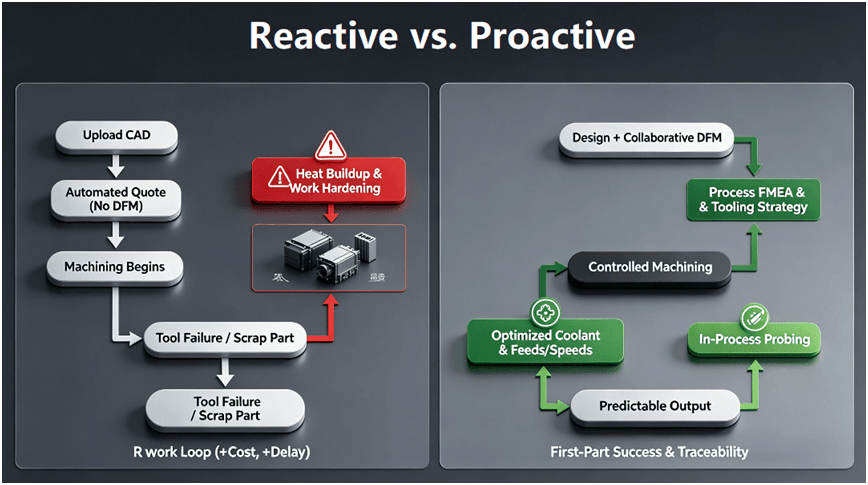
- AS9100D and IATF 16949 as System Design Documents: These standards require a risk-based approach and preventative measures. Prior to machining a sophisticated 316L vessel, a multidisciplinary team performs Failure Mode and Effects Analysis (FMEA) unique to the material properties. The result is proactive control through specialized fixture design to prevent vibrations, in-process probing cycles to correct for tool flexure, and coolant optimization techniques to mitigate heat buildup. These engineering steps, mandated by the standards, represent the greatest cost savings and risk reduction strategy, preventing catastrophic work hardening and deformation associated with stainless steel machining.
- Closed-loop digital thread for full traceability: The integration process implies the establishment of continuous digital thread accountability. Each manufactured part made of stainless steel can be digitally traced back to the CAD revision used, the CAM software, the machine and cutting tool utilized, the operator working on it, and the batch of raw material supplied with a mill test certificate. This level of materials and processes traceability is what is required by these standards. Such traceability allows instant root cause analysis, forming the foundation of confidence in mission-critical manufacturing operations. Engineers who select specialized materials must know about the manufacturer’s proficiency in traceability, something that can be found in materials of reputable CNC milling stainless steel manufacturers.
- The Culture of Engineering Excellence: The certifications will thus institutionalize the culture of excellence by ensuring continuous improvement and effective implementation through documentation, audits, and corrective actions. When working together with a partner who has this culture, the company gets involved with a system that is self-corrective and constantly learns. It means that the company’s ability to utilize its engineering expertise to resolve issues related to stainless steel processing using optimized roughing, tool life management, and distortion control is consistently maintained and practiced in an ethical manner.
H2: Conclusion
Stainless steel machining is one of the most challenging processes when it comes to knowledge of the material and quality management. Procurement of such machining services should be done strategically. Using the criteria of assessment of the process efficiency of the partners mentioned above-the efficiency of automation of Protolabs, network governance of Xometry and Hubs, collaboration of Fictiv, agility of 3ERP, integration capacity of Rapiddirect, systemic approach of Jabil, and quality management systems of LS , an OEM leader will be able to make right decisions based on which reliable partnerships can be built. With the help of these partners and their engineering solutions, problems associated with the use of stainless steel can be addressed, quality can be ensured, and significant savings can be achieved.
H2: FAQs
Q1: How do you confirm “One-Stop Manufacturing Services” offered by a company?
A.This should be confirmed through an audit of the closed-loop process chainof the company. The one-stop manufacturing process requires control and documentation of every process including the sourcing and processing of raw materials, precise machining, finishing, assembling, and inspection. Certification in the IATF 16949process is good proof of systematic quality management within the entire process.
Q2: What is the most difficult aspect of making precision parts out of stainless steel using CNC machining?
A.The most difficult part of this process is regulating its high work hardening and low thermal conductivity characteristics. This involves advanced knowledge in cooling processes, optimizing the machining tools, and making compensations during the manufacturing process as recommended in smart manufacturing by NIST.
Q3: What significance does having ISO 14001 certification have with respect to my stainless steel machining project?
A.An ISO 14001 certification indicates a company’s commitment to environmental management and efficiency. With respect to the machining of stainless steel, this implies effective utilization of coolants, metal chips, and other waste, leading to better operational stability. Process consistency and a low risk supply chain can be ensured through ISO 14001 certification.
Q4: How do I deal with conflicting requirements in the technical evaluation process?
A.When undertaking a technical evaluation, it should always involve prioritization of fundamental engineering practices and standards. The speed should come at the expense of what is required to reach the necessary precision and quality of the materials. It should lean more toward those whose engineering designs are rooted in physics and facts rather than quick turnaround times.
Q5: How is “High Efficiency CNC Machining” characterized for complex components?
A.High Efficiency CNC Machining is not just about maximizing spindle speeds. It must involve systematic optimization through thorough DFM cooperation to make single setup machining possible, efficient toolpaths to optimize cutting loads, and integrated logistics to avoid time-consuming handoffs. Be cautious when receiving automated quotes without DFM expertise as the true costs of rework and delays can easily outweigh savings.
H3: Author Bio
This writer is an expert in manufacturing systems field. Their major area of focus is how advanced quality standards and precision engineering techniques can be used to unravel complex issues with materials. Besides, the writer works hand in hand with the LS Manufacturing team and they concentrate their shared energies on helping Original Equipment Manufacturers (OEMs) to be able to reduce their supply chain risks effectively by means of thorough and careful examination during the selection of partners.