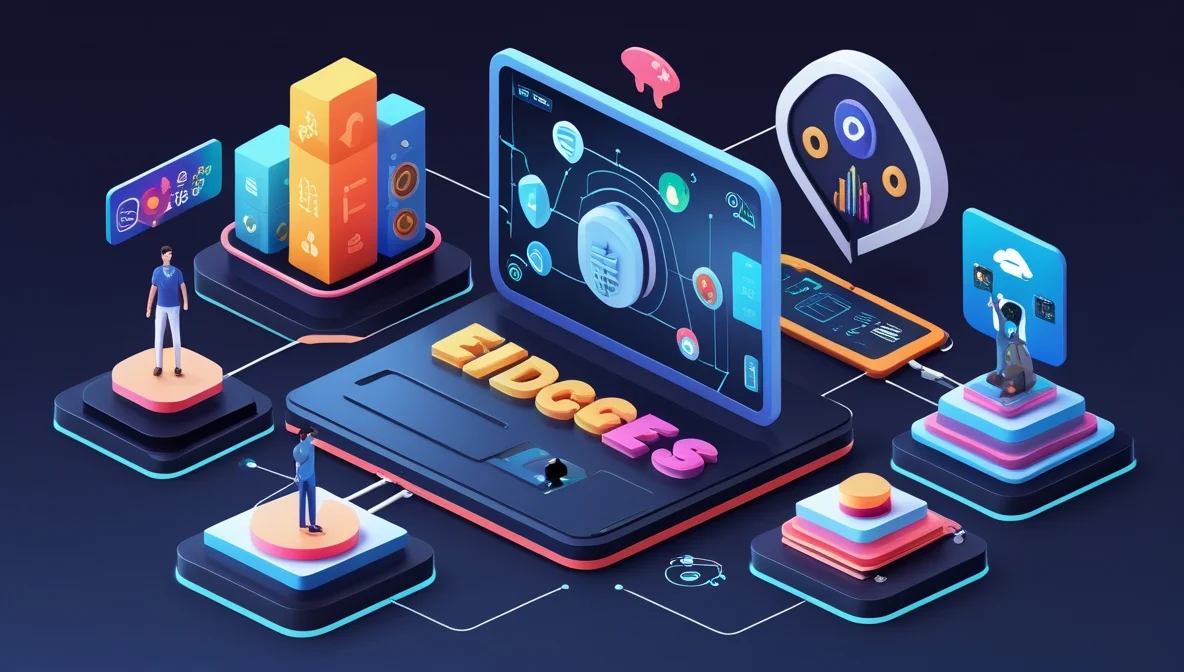
Edge Computing Use Cases for Developers: Real-World Apps Beyond the Hype
What is edge computing use cases for developers. Imagine a self-driving car. It’s speeding down the highway. A child’s ball rolls into the street. The car must react. Instantly. Now, imagine that car has to send a signal to a data center 500 miles away and wait for a response.
Please, cloud computer, can I brake now? It’s a disaster. That’s the problem. The cloud is brilliant, but it’s far away. This is where edge computing crashes the party. For developers, understanding edge computing use cases for developers is no longer a niche skill.
It’s becoming essential. It’s about putting the brains right where the action is. Let’s break down what this really means for you, the coder.
The Cloud is Too Far Away: The “Why” Behind the Edge
Think of the cloud as a giant, super-smart brain in a secret laboratory. It’s powerful. But it’s slow to respond to emergencies in your hometown. The edge is like having a smart, local helper right on your street. They can make quick decisions without calling the lab. This is the core of distributed computing for developers.
The math is simple. Light and data can only travel so fast. That speed limit is physics. Sending data to the cloud and back, a round trip called latency, takes time. Sometimes 100 to 200 milliseconds. For many applications, that’s fine. For an increasing number, it’s a lifetime.
- A laggy video call is annoying.
- A laggy industrial robot is dangerous.
- A laggy financial trade loses millions.
This need for speed is the engine of the edge. It’s the foundation for countless edge computing applications. It’s not about replacing the cloud. It’s about teaming up with it. A cloud-edge hybrid system is the future. The cloud does the heavy, long-term thinking. The edge handles the instant, life-or-death decisions.
The Real Deal: Where Edge Development Shines
Enough theory. Let’s get our hands dirty. Where does this actually work? What are the concrete developer use cases for edge computing? Here are the areas where it’s not just better—it’s mandatory.
Smart Factories and the Internet of Things (IoT)
A factory floor is a symphony of chaos. Sensors on conveyor belts track products. Robots weld parts. Cameras check for defects. This generates a tidal wave of data. Sending all this to the cloud is expensive and slow. IoT edge applications process this data right there.
The Win: A camera spotting a defective product can signal a robotic arm to flick it off the line in milliseconds. This is real-time data processing at the edge. The edge data pipeline only sends summary data (e.g., “5 defects found today”) to the cloud for reporting. The real-time action stays local.
The Toolbox: Platforms like AWS IoT Greengrass or Azure IoT Edge let you package your code in containers and run it directly on industrial gateways.
The Boom of Real-Time Video and Image Analysis
Security cameras are everywhere. But watching live feeds is a boring job. And storing all that video in the cloud costs a fortune. Edge AI development changes the game.
The Anecdote: A retail store uses cameras not to stream video, but to run people-counting algorithms at the edge. The camera itself, or a small local device, runs a model that counts customers.
It doesn’t send video. It just sends a number: “The store is 60% full.” This saves bandwidth and privacy headaches. This is a powerful edge computing use case for developers in the retail space.
The Tech: You can deploy optimized TensorFlow Lite or PyTorch models to devices like NVIDIA Jetson or even smartphones for edge-based machine learning.
The Immersive World: AR, VR, and Cloud Gaming
Put on an Augmented Reality headset. Your digital dinosaur should sit perfectly on your real-world table. If it lags or jitters, you get sick. The magic circle breaks. Low-latency computing use cases are the hero here.
The Flop: An early AR game tried to do all its object recognition in the cloud. The result? A wobbly, nauseating experience that never took off. The lesson was learned.
The Win: Modern AR glasses do the heavy visual processing locally (edge device programming). They might only pull specific 3D model data from the cloud. This split-second speed is what makes the experience feel real and comfortable. This is a killer edge development use case for the metaverse builders.
The Connected Future: 5G and Smart Cities
5G and edge computing are a power couple. 5G is the super-fast highway. Edge computing is the rest stop with all the services right there. A smart traffic light system can’t wait for the cloud. It needs to talk to nearby cars and other lights now.
The Scenario: An ambulance is rushing to the hospital. Edge computing architecture at a nearby cell tower gets the signal. It instantly turns all the upcoming lights green, creating a clear path. This decision happens in under 10 milliseconds. The cloud is informed later for log analysis. This is computing at the network edge saving lives.
Your New Playground: Tools and Architectures
So, how do you actually build this stuff? The old ways of coding don’t always fit. The edge demands a new mindset.
The Microservices Mindset, But Tinier
You know microservices. Now think even smaller. Edge microservices are lightweight, single-purpose functions. They do one job well with minimal resource use. Think of a service that just reads a temperature sensor. Another that just controls a motor. They chatter to each other locally.
Serverless Comes to the Edge
Yes, you read that right. Serverless edge computing is a thing. AWS Lambda@Edge and CloudFlare Workers let you run functions on a global network of edge locations. You don’t manage the server.
You just write the code. This is perfect for customizing website content for users or handling API requests closer to the source. It’s a fantastic entry point for edge computing for software developers.
Containers, Containers, Containers
Docker and Kubernetes won the cloud. They’re winning the edge too. Tools like K3s (a lightweight Kubernetes) are designed to run on low-power devices.
You can package your application and its dependencies into a container and deploy it consistently across a thousand edge devices. This is the backbone of scalable edge computing architecture.
The Gritty Challenges: It’s Not All Sunshine
The edge is cool. But it’s also hard. It’s the wild west compared to the polished cloud.
- Limited Resources: Your server might have 256GB of RAM. Your edge device has 512MB. You have to code efficiently. Every CPU cycle and megabyte of memory counts.
- Deployment Nightmares: Updating software on one cloud server is easy. Updating 10,000 security cameras scattered across a country is a logistical nightmare. You need robust over-the-air update strategies.
- Security Headaches: A cloud data center is a fortress. An edge device might be in a public place. Anyone can physically tamper with it. Security must be baked in from the start.
This is where the real engineering grit comes in. Building for the edge isn’t just writing code. It’s about understanding the entire physical lifecycle of your application.
Getting Your Hands Dirty: A Starter Project
Want to try it? Don’t start with a self-driving car. Start with a Raspberry Pi.
- Get a Raspberry Pi 4. This is your perfect, cheap edge device.
- Install a camera module.
- Write a Python script. Use the OpenCV library to detect motion.
- Make it smart. Instead of sending video anywhere, just have it send you a Telegram message: “Motion detected in the kitchen!”
Congratulations. You’ve just built a basic IoT edge application. You processed data locally and only sent a tiny, useful alert. That’s the edge philosophy in a nutshell.
The Bottom Line: Why This Matters for Your Career
The trend is undeniable. Gartner predicts that by 2025, over 75% of enterprise data will be created and processed at the edge. That’s a staggering shift. For developers, getting ahead of this curve is smart.
The edge computing use cases for developers we’ve explored are just the beginning. From retail to manufacturing to entertainment, the demand for skills in real-time data processing at the edge and edge AI development will only explode. Learning this now positions you at the forefront of the next computing revolution.
FAQs: Your Edge Computing Questions, Answered
1. What is the main difference between cloud and edge computing?
Think of cloud computing as a centralized brain for deep analysis and storage. Edge computing is a network of local nervous systems making split-second decisions. The cloud is for heavy lifting; the edge is for instant reaction.
2. Do I need to learn a whole new programming language for edge development?
Not necessarily. Languages like Python, Go, Rust, and C++ are very common. The bigger shift is learning to write efficient, resource-conscious code and understanding new platforms and tools specific to edge deployment.
3. What are some developer-friendly edge platforms to start with?
AWS IoT Greengrass, Azure IoT Edge, and CloudFlare Workers are great starting points. They offer good documentation and free tiers to experiment with, letting you run your code in an edge-like environment without buying hardware upfront.
4. When should I definitely NOT use edge computing?
Avoid the edge for tasks that require massive data aggregation from countless sources, long-term historical analysis, or when your application isn’t sensitive to a few hundred milliseconds of delay. The cloud is still king for batch processing and big data analytics.
5. Is edge computing only for IoT and AI?
While IoT and AI are the biggest drivers right now, the principles of low-latency computing apply anywhere speed is critical. This includes content delivery networks (CDNs), real-time collaborative apps, and financial trading systems, proving that edge computing applications are diverse.
Your Move, Developer
The cloud isn’t going away. But the action is moving to the edge. It’s a world of constrained devices, real-time demands, and unique problems. It’s also a world of massive opportunity. The most exciting edge computing use cases for developers are probably still in a garage somewhere, being dreamed up.
You can wait for the future to arrive. Or you can start building it. Grab a Raspberry Pi. Break something. Learn. The edge is waiting, and it needs your code.
References:
- Gartner. (2023). “What Edge Computing Means for Infrastructure and Operations Leaders.”
- AWS Whitepapers. (2023). “AWS Edge Computing Overview.”
- The Linux Foundation. (2023). “State of the Edge Report.”
- NVIDIA Developer Blog. (2023). “Getting Started with AI at the Edge.”
Read More: Top Cybersecurity Threats For Startups