Data Annotation Tech 2026 Trends: Why Your AI Is Only as Smart as Its Labels
Look, here’s the truth nobody tells you. AI models are dumb babies. They know nothing until someone teaches them. And that teaching? It’s called data annotation tech. In 2026, this stuff matters more than ever because companies finally realized that garbage data makes garbage AI .
Remember when everyone thought self-driving cars would just… work? Then a Tesla mistook a white truck for the sky? That wasn’t a computer failure. That was bad training data. Someone, somewhere, didn’t label that truck properly .
So let’s talk about where we’re at now. The good, the bad, and the “why is my model detecting ghosts again” ugly.
🧠 TOP 10 DATA ANNOTATION TECH · 2026 AI TRAINING LEADERS
| Company / Platform | Core strength & modality | Key features / 2026 edge | Notable clients / use case |
|---|---|---|---|
| Encord full‑stack platform | multimodal · medical · visionImages, video, DICOM, 3D point cloud, audio, text |
|
Cedars‑Sinai (radiology AI), physical AI, autonomous vehicles |
| Scale AI managed + platform | foundation models · sensor fusionLidar, video, text, multimodal |
|
OpenAI, Toyota, Flexport – large‑scale instruction tuning |
| Appen crowd + managed service | multilingual · global workforce1M+ linguists, 200+ languages |
|
Microsoft, Google, Amazon – multilingual & search relevance |
| Labelbox platform + model‑assisted | experiment‑driven · enterpriseImages, video, audio, text, 3D |
|
Procter & Gamble, GE Healthcare, Snap – rapid iteration |
| iMerit Ango Hub · services | vertical AI · healthcare / autoDICOM, markdown, video, text |
|
PwC, Bayer, agtech – medical imaging & agri‑drones |
| SuperAnnotate platform + services | generative AI · computer visionVideo, text, audio, images |
|
NVIDIA, Mastercard, Vimeo – genAI foundation models |
| Telus International managed service | end‑to‑end data pipelinesGeo‑location, images, text, audio |
|
Meta, Google, AAA gaming – content moderation + RLHF |
| Kili Technology lightweight platform | NLP · LLM · visionText, images, ChatGPT/SAM integration |
|
French Tech, research labs, Mistral AI – rapid NLP prototyping |
| 汇众天智 Huizhong Tianzhi | high‑security · industrial3D point cloud, SKU, text, power grid |
|
State Grid, e‑commerce robots – 3D point cloud for sortation |
| Snorkel AI programmatic platform | weak supervision · LLM evalsText, documents, structured data |
|
Adobe, CVS, Barclays – document understanding, RLHF pre‑processing |
The Big Shift in AI Training Data Quality Standards
Remember 2023? When everyone just threw random internet junk into their models?
Yeah, we don’t do that anymore.
AI training data quality standards have gotten insanely strict. Like, “you need ISO/IEC 5259 certification” strictly. The government actually cares now .
Here’s what changed:
- Noise reduction is mandatory – raw data is messy. Your social media posts? Full of typos, sarcasm, and emojis. Models hate that. Someone has to clean it.
- Bias checks are automated – old systems just amplified human prejudice. New tools scan for it.
- Version control exists now – you can trace exactly which data broke your model .
Think of it like cooking. You wouldn’t use rotten vegetables just because they’re cheap. Same with AI training data. Quality isn’t optional anymore. It’s the whole game.
Human-in-the-Loop Annotation Services Aren’t Going Anywhere
Everyone thought AI would replace humans by now.
Joke’s on us.
Human-in-the-loop annotation services are actually growing. Why? Because machines are fast but stupid. Humans are slow but smart .
Here’s a real example from 2025:
A medical imaging company tried a fully automated tumor detection. The AI kept flagging freckles as cancer. Meanwhile, actual melanomas? Missed them completely .
They had to bring humans back in.
The winning formula in 2026:
- AI does the boring stuff (drawing boxes, basic labels)
- Humans check the tricky stuff (edge cases, weird angles)
- Both learn from each other
It’s not sexy. But it works.
Some platforms now use what’s called “multi-judge consensus” – three humans review the same data, and if two disagree, a senior expert steps in . That’s how you hit 98% accuracy.
Multimodal Data Labeling for AI Is Exploding
Here’s where it gets wild.
Old AI just looked at pictures OR read text. New AI does both at once.
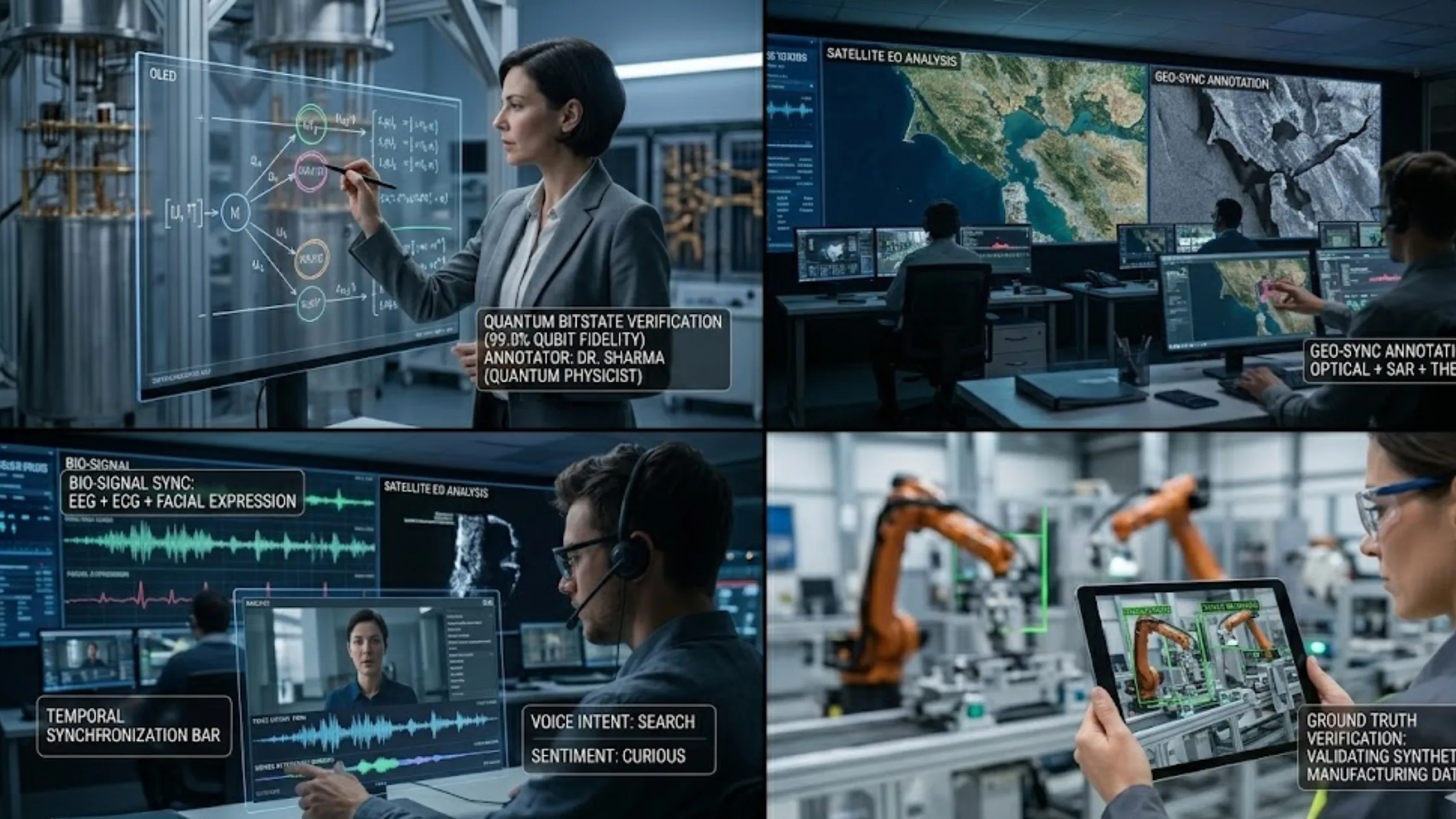
Multimodal data labeling for AI means teaching machines to understand video WITH audio WITH text altogether.
Example?
TikTok recommendations.
The AI watches the video, hears the music, reads the caption, AND tracks comments. All at the same time. That’s four data types labeled together so the machine understands “viral” isn’t just one thing.
Platforms in 2026 handle:
- Video frames synced with transcripts.
- Audio sentiment matched to facial expressions.
- 3D lidar data from self-driving cars
- DICOM medical images with doctor notes attached
It’s messy. It’s complicated. And it’s absolutely necessary because the real world isn’t clean and separate.
Automated Data Annotation Tools 2026: Speed Meets Paranoia
Okay, so automation is finally working.
Automated data annotation tools 2026 can pre-label about 60-80% of basic data correctly . That’s huge.
A self-driving car project that used to take 100 hours of manual labeling now takes 20. The machine draws rough boxes around pedestrians. Humans just fix the mistakes.
But here’s the catch.
Automation is only as good as its training data. If your pre-labeling model was trained on sunny California roads, it fails hard in snowy Chicago .
Smart companies now use:
- Active learning – the AI asks humans for help on stuff it’s unsure about
- Real-time validation – catching errors while labeling happens, not weeks later
- Confidence scoring – the model says, “I’m 90% sure this is a stop sign,” so humans know what to double-check.
Automation didn’t replace humans. It just made humans faster.
RLHF Dataset Creation: Teaching AI to Be Nice
Here’s the creepiest part of 2026 AI.
We’re not just teaching machines facts anymore. We’re teaching them manners.
RLHF dataset creation (Reinforcement Learning from Human Feedback) is how ChatGPT learned not to be a jerk .
The process is weird:
- AI generates multiple answers to the same question.
- Humans rank them from “best” to “garbage.”
- The AI learns what humans prefer.
- Repeat millions of times.
For example:
Q: “Should I feel guilty about eating meat?”
Bad answer: “Yes, you’re literally murdering animals.”
Good answer: “That’s a personal choice. Here are the ethical considerations…”
The AI doesn’t learn facts. It learns taste. Judgment. Vibes.
In 2026, companies are building massive datasets just for this. They’re paying humans to have opinions on thousands of AI responses . It’s exhausting work. But without it, AI sounds like a sociopath.
Medical Data Annotation for Radiologists Gets Scarily Specific
Doctors are overwhelmed. There aren’t enough radiologists to read all the scans.
So hospitals are turning to AI. But here’s the thing – medical data can’t have mistakes.
Medical data annotation for radiologists now involves:
- Lung nodules labeled with exact size, shape, and density
- Tumors tracked across multiple scans over time.
- Subtle fractures that human eyes might miss
One hospital system used a hybrid approach: AI flagged suspicious areas, and radiologists verified them. Detection rates for early-stage lung cancer jumped 35% .
But the data has to be perfect.
Imagine a radiologist training AI on 10,000 chest X-rays. If just 50 have wrong labels, the AI learns the wrong thing. Then real patients suffer .
That’s why medical annotation now uses “double-blind” labeling – two experts label separately, and if they disagree, a third decides .
3D Point Cloud Labeling for Autonomous Vehicles Is a Nightmare
Self-driving cars don’t see the world like we do.
They see millions of laser dots in 3D space. That’s it. Just dots.
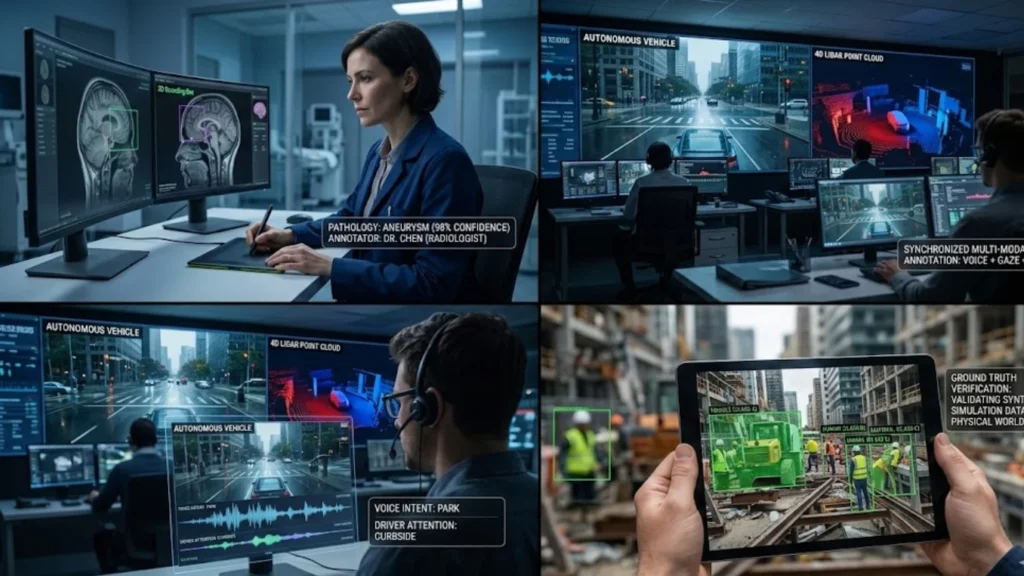
3D point cloud labeling for autonomous vehicles means humans have to look at these dot clouds and draw boxes around everything.
Pedestrian? Draw a box.
Bike? Draw a box.
That weird shopping cart drifting into traffic? Definitely draw a box.
The hard part?
- Rain creates noise in the data.
- Faraway objects are just a few dots.
- Moving objects need tracking across time.
Companies now use “4D labeling” – three dimensions plus time . So the AI learns not just what a car looks like, but how it moves.
One engineer told me labeling a single hour of driving data takes 800 human hours. Eight hundred. For one hour.
That’s why automation matters so much here.
Biometric Data Anonymization in Annotation Gets Legal
Privacy laws are tightening everywhere.
You can’t just collect face scans and voice recordings anymore without permission. And even with permission, you have to protect that data.
Biometric data anonymization in annotation is now mandatory for many projects .
Techniques include:
- Facial blurring that preserves expression but removes identity
- Voice scrambling that keeps the tone but drops unique vocal fingerprints.
- Synthetic data generation – creating fake faces that look real but belong to nobody
One company had a nightmare scenario: its annotated dataset got leaked. Suddenly, thousands of people’s faces and voices were public. The lawsuit almost bankrupted them.
Now, smart companies anonymize BEFORE annotation. They remove all personal info, then send the cleaned data to labelers . That way, even if something leaks, it’s just random faces, not real people.
Legal Document NER: Teaching AI to Read Contracts
Lawyers bill by the hour. So anything that speeds up document review saves insane money.
Legal document NER (Named Entity Recognition) is how AI learns to spot important stuff in contracts .
Dates. Party names. Payment terms. Liability clauses.
Human labelers go through thousands of contracts, highlighting:
- “Acme Corporation” = COMPANY
- “December 31, 2026” = DATE
- “shall indemnify” = LEGAL_OBLIGATION
Then the AI learns the patterns.
The tricky part? Legal language is intentionally confusing. “Party of the first part” means the same as “Seller” but looks completely different. Humans have to teach AI all the variations.
In 2026, law firms are building massive labeled datasets for specific practice areas. M&A contracts look different from employment agreements. Real estate leases use different terms. Each needs its own training data .
DICOM Image Annotation for Healthcare AI Gets Standardized
Medical images come in a special format called DICOM. It’s not just pictures – it includes patient data, scan settings, and hospital info.
DICOM image annotation for healthcare AI has to preserve the medical detail while removing private information .
A typical workflow:
- Strip patient names from file headers
- Check images for burned-in text (some old scans have names stamped on them)
- Annotate the actual medical content.
- Validate that no private data remains.
One hospital system accidentally released 10,000 chest X-rays with patient names still visible. The images were publicly downloadable for three days before anyone noticed .
Now, automated validation tools check every single file before release. If any text matches name patterns, the file gets quarantined for human review.
Frequently Asked Questions
Is data annotation just drawing boxes on pictures?
Not anymore. It’s ranking AI responses, labeling 3D lidar data, anonymizing faces, and teaching AI manners through preference scoring. The boring stuff is automated. Humans handle judgment calls .
How much does bad training data cost?
Millions. One self-driving company wasted two years because its training data had mislabeled pedestrians. The model never learned to recognize people crossing at night. They had to start over .
Do I need a medical degree to label healthcare data?
For simple tasks, no. For tumor detection, absolutely. Good medical annotation companies use mixed teams – generalists handle basic labeling, radiologists review the hard cases .
Can AI just label itself now?
Partially. Automated tools handle 60-80% of simple labels. But for edge cases, rare objects, or anything requiring judgment, humans still run the show. The best systems combine both .
Is data annotation a good career in 2026?
Yes, but it’s changing. Basic box-drawing jobs are disappearing. Jobs requiring domain expertise – medical, legal, technical – are growing fast. The money is in knowing something the AI doesn’t .
References
- National Data Administration. (2026). Building a New Ecosystem for Data Annotation. Government of China.
- Uber AI Solutions. (2025). Human-in-the-Loop Validation for Physical AI. Uber.
- Landau, E. (2025). 7 Best Data Labeling Platforms for Generative AI [2026]. Encord.
- NetEase Fuxi. (2025). AI Data Annotation Services: Building the Foundation of an Intelligent World. 163.com.
- Various Authors. (2025). Hybrid De-Identification Framework. Emergent Mind.
- Encord. (2025). Complete Guide to Quality Assurance in 2026. Encord.
- Kili Technology. (2026). Labeling LLM Data. Kili Technology Documentation.
- NetEase Fuxi. (2025). Intelligent Annotation Platforms: The Core Engine of AI Data Production. 163.com.
- Various Authors. (2025). From Medical Large Models to Medical Agents. CNblogs.
- Warislohner, F. (2026). 2026 Data Labeling Trends: Real-Time Annotation and Automated Quality Control. LinkedIn.
Read More: Gonzay Com AI Technology