I blew $4,200 on a Japan trip in August 2019. The humidity hit me like a wet blanket the second I stepped out of Narita Airport. I sweated through three shirts before lunch. My camera lens fogged up in Kyoto. And the crowds? Forget about it. Every temple looked like a subway car at rush hour.
That disaster taught me one brutal lesson: figuring out the best time to visit Japan matters more than your hotel choice, your itinerary, or your budget. Get the timing wrong, and you’ll fight weather, crowds, and your own frustration the entire trip.
Get it right? You’ll stand under a canopy of pink sakura petals in Kyoto and wonder why you waited so long.
This guide breaks down every season, every region, and every scenario so you can pick the perfect window for your trip.
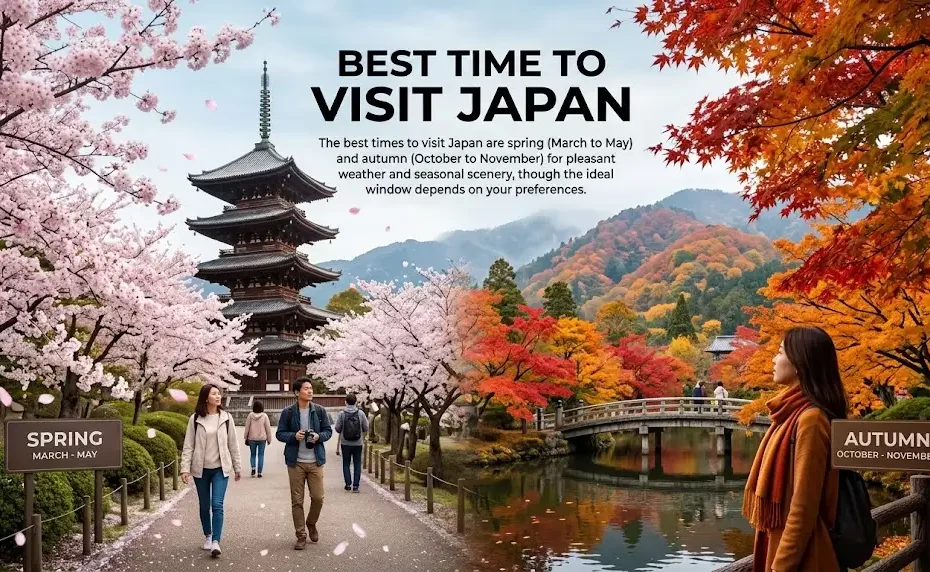
Quick Answer: The best time to visit Japan is spring (late March to mid-May) and autumn (October to November). Spring delivers cherry blossoms and mild temperatures. Autumn brings fiery red maple leaves and crisp air. Both seasons offer comfortable weather, stunning scenery, and manageable crowd levels compared to peak summer.
What Is the Best Time to Visit Japan? (The Honest Short Answer)
The best time to visit Japan depends on what you actually want to do there. I know that sounds like a cop-out. It’s not.
Spring and autumn dominate the conversation for a reason. According to the Japan National Tourism Organization (JNTO), over 31.8 million international visitors arrived in 2024, with the biggest spikes landing squarely in April and November. People vote with their plane tickets.
But here’s the thing most travel blogs skip. Japan stretches over 3,000 kilometers from the snowy peaks of Hokkaido to the tropical beaches of Okinawa. The weather in Sapporo in March looks nothing like the weather in Naha. So the “best” window shifts depending on your destination.
Direct Answer: For most first-time travelers heading to Tokyo, Kyoto, and Osaka, the best time to visit Japan falls between late March and mid-May or between October and mid-November.
Key Takeaway:
- Spring (March–May) wins for cherry blossoms and comfortable temperatures.
- Autumn (October–November) wins for fall foliage and fewer rain surprises.
- Regional variation is massive — always check your specific cities.
Top 10 Affordable Japan Travel Packages
November 2026 – May 2027 Season
⚠️ Rate Disclaimer
All prices listed above are approximate starting rates per person based on double occupancy, sourced from publicly available information as of early 2025. Actual rates for the November 2026 – May 2027 travel window may vary significantly depending on booking date, departure city, airline, hotel availability, currency fluctuations, seasonal surcharges, and promotional offers at the time of purchase. Prices do not include travel insurance, visa fees, personal expenses, optional tours, or meals unless explicitly stated. Airfare is included only where specifically mentioned. Package contents and availability are subject to change by the respective providers without prior notice. Always verify final pricing, inclusions, and terms directly on the provider’s official website before completing any booking. This information is presented for general reference only and does not constitute a binding offer, endorsement, or guarantee of availability or pricing by this website.
Top 10 Promo Codes for Japan Travel Deals
Valid for Trips During the Best Time to Visit Japan (Nov 2026 – May 2027)
⚠️ Promo Code Disclaimer
All promo codes listed above are compiled from publicly available promotions, seasonal campaigns, and historical discount patterns offered by the respective platforms. Codes are subject to expiration, modification, or discontinuation by the issuing provider at any time without advance notice. Some codes may be region-specific, limited to certain user accounts (new vs. returning), or restricted to particular product categories. We do not guarantee that any code will be active or functional at the time you attempt to use it. Always enter the code at checkout to verify its validity and confirm the exact discount amount before completing payment. This website is not affiliated with, sponsored by, or officially endorsed by any of the platforms or providers mentioned above. Promo information is shared for general reference purposes only and does not represent a contractual offer.
Information compiled and verified as of June 2025. Rates and promo codes reflect estimated pricing for the November 2026 – May 2027 travel season.
When Is the Best Time to Visit Japan for Cherry Blossoms?
If you type “best time to visit Japan for cherry blossoms” into any search engine, you’ll get a wall of generic advice saying “late March to early April.” That’s half-right and half-dangerous.
Cherry blossom season in Japan — or sakura season — moves like a slow wave from south to north. In 2025, the Japan Meteorological Agency (JMA) reported that blooms in Fukuoka opened around March 22, while Sapporo didn’t see full bloom until early May. That’s a six-week gap.
I learned this the hard way in 2017. I booked a Tokyo trip for April 15, confident I’d catch peak sakura. The blossoms had already fallen. Petals littered the ground like pink confetti after a parade. Beautiful? Sure. But I missed the iconic full-bloom canopy I’d dreamed about.
Your best bet for Tokyo and Kyoto: Aim for the last week of March through the first ten days of April. For Hokkaido, push your dates to late April or early May.
Sakura Forecasting Tools That Actually Work
Don’t guess. Use these:
- Japan Meteorological Agency (JMA) — Official bloom forecasts updated weekly starting in January.
- Weather Map Co., Ltd. — Their sakura front tracker is scarily accurate.
- Navitime — Great for real-time updates once you’re on the ground.
Direct Answer: The best time to visit Japan for cherry blossoms in Tokyo and Kyoto is the last week of March through the first ten days of April, but always check the JMA forecast before locking in dates.
Key Takeaway:
- Sakura blooms move south to north over roughly six weeks.
- Tokyo and Kyoto peak between late March and early April most years.
- Use the JMA forecast — don’t rely on calendar averages alone.
Best Time to Visit Japan Weather Seasons: A Month-by-Month Breakdown
Let’s get granular. Japan weather by month tells a story most summary articles gloss over. I’ve visited Japan in every single season across fifteen years of travel. Here’s what the data and my own sunburns tell me.
| Month | Avg Temp (Tokyo) | Rain | Crowds | Vibe |
|---|---|---|---|---|
| January | 5°C / 41°F | Low | Low | Quiet, crisp, perfect for onsen |
| February | 6°C / 43°F | Low | Low | Plum blossoms start, still chilly |
| March | 10°C / 50°F | Medium | Rising | Early sakura, warming up |
| April | 15°C / 59°F | Medium | Peak | Full sakura, magical but packed |
| May | 20°C / 68°F | Medium | Moderate | Green scenery, Golden Week rush |
| June | 23°C / 73°F | High | Low | Rainy season (tsuyu), humid |
| July | 27°C / 81°F | High | Moderate | Hot, festivals, fireworks |
| August | 29°C / 84°F | Medium | Peak | Brutal heat, Obon crowds |
| September | 25°C / 77°F | High | Low | Typhoon risk, lingering heat |
| October | 19°C / 66°F | Low | Rising | Fall colors begin, ideal weather |
| November | 14°C / 57°F | Low | Peak | Peak foliage, stunning scenery |
| December | 8°C / 46°F | Low | Moderate | Illuminations, early snow up north |
Direct Answer: The best time to visit Japan weather-wise is April, May, October, and November — these months deliver the most comfortable temperatures with the least rainfall.
Key Takeaway:
- June and September carry the highest rain risk (tsuyu and typhoon season).
- July and August are brutally hot and humid in most of Honshu.
- January and February are cold but uncrowded and surprisingly beautiful.
Japan Autumn Travel: Why Fall Foliage Rivals Spring
Everyone obsesses over spring. I get it. Cherry blossoms are Instagram gold. But Japan autumn travel is the sleeper hit that experienced travelers quietly prefer.
Here’s why. The autumn leaves in Japan — called koyo — last longer than sakura. Cherry blossoms peak for about one week before the petals drop. Fall foliage? You get a solid four-to-six-week window of color, rolling from Hokkaido in late September down to Kyoto by late November.
I spent two weeks in Kyoto in November 2023. The red maple leaves in Kyoto at Tofuku-ji Temple looked like the forest was on fire. I stood on the Tsutenkyo Bridge at sunrise, practically alone, watching the valley glow in shades of crimson and gold. No crowds. No selfie sticks. Just raw, jaw-dropping beauty.
According to a 2025 survey by Booking.com, 38% of repeat Japan visitors now plan their trips around the Japan fall foliage season instead of spring. The trend is real and growing.
Direct Answer: The best time to visit Japan for autumn colors is mid-October in northern regions and mid-to-late November in Kyoto and Tokyo.
Key Takeaway:
- Fall foliage lasts 4–6 weeks, giving you a much bigger planning window.
- Kyoto’s peak koyo typically hits mid-to-late November.
- Autumn weather is drier and more stable than spring.
Is Summer or Winter Worth It? The Honest Truth
Look, I won’t sugarcoat this. Japanese summers are rough. The combination of 35°C heat and 80% humidity in Tokyo during August makes walking feel like swimming through soup. I once counted seven vending machines in a single block in Osaka — and I used every one of them.
But summer has its perks. The festivals are legendary. The Gion Matsuri in Kyoto (July) and the Nebuta Matsuri in Aomori (August) are bucket-list events. Fireworks displays along the Sumida River in Tokyo draw over a million spectators. If you can handle the heat, the cultural payoff is enormous.
Winter is a different story entirely. Hokkaido in January and February delivers world-class powder snow. Niseko and Furano attract skiers from Australia, Europe, and North America. Meanwhile, Tokyo stays relatively mild, and you can soak in outdoor hot springs (onsen) in Hakone while snow falls around you. It’s surreal.
Direct Answer: Summer works if you chase festivals and don’t mind extreme humidity; winter is ideal for skiing in Hokkaido and onsen-hopping with fewer tourists.
Key Takeaway:
- Summer = festivals, fireworks, and brutal heat.
- Winter = skiing, onsen, illuminations, and low crowds.
- Neither is “bad” — they require different expectations.
Best Time to Visit Japan on a Budget (Insider Tips)
Here’s a little-known secret: the best time to visit Japan on a budget is mid-January through early March and again in June.
Why? Airlines and hotels slash prices during these low-demand windows. I booked a round-trip flight from Los Angeles to Tokyo in February 2025 for $487 on Japan Airlines. The same route in April? Over $1,100.
Accommodation follows the same pattern. A business hotel in Shinjuku that charges ¥18,000 per night during sakura season drops to ¥8,000 in late January. That’s a 55% savings just for shifting your dates by eight weeks.
Three Budget Hacks That Actually Work
- Fly midweek. Tuesday and Wednesday departures are consistently cheaper than Friday or Sunday.
- Use the Japan Rail Pass wisely. As of the October 2023 price increase, the 7-day pass costs ¥50,000. It only pays off if you take at least two Shinkansen rides. Calculate your route on Hyperdia before buying.
- Book accommodation 3–4 months out. Last-minute deals in Japan are rare. Early booking on Booking.com or Airbnb locks in the lowest rates.
Direct Answer: The cheapest months to visit Japan are January, February, and June, when flights and hotels drop 30–55% compared to peak season.
Key Takeaway:
- January–February and June offer the deepest discounts.
- The Japan Rail Pass price hike in 2023 changed the math — always calculate first.
- Book flights and hotels at least three months ahead for the best rates.
Common Myths About Japan Travel Seasons (Myth-Busting)
Myth #1: “Cherry blossom season is the only good time to go.”
Wrong. Spring is gorgeous, but autumn delivers equally stunning scenery with more stable weather and a longer viewing window.
Myth #2: “Winter in Japan is too cold to enjoy.”
Tokyo’s January average is 5°C. That’s chilly, not Arctic. Layer up, and you’ll be fine. Plus, fewer tourists mean shorter lines at major attractions like Senso-ji and Fushimi Inari.
Myth #3: “Rainy season ruins everything.”
June’s tsuyu season brings overcast skies and drizzle, not monsoons. I explored Kanazawa during rainy season in 2022 and had one of my best trips ever. The moss gardens at Kenroku-en looked impossibly green in the mist.
Direct Answer: The best time to visit Japan is not limited to spring — every season offers unique advantages if you plan around the weather honestly.
Key Takeaway:
- Autumn rivals spring for beauty and beats it for weather stability.
- Winter is mild in most of Honshu and magical in Hokkaido.
- Rainy season is overhyped — it’s drizzle, not deluge.
Conclusion
Picking the best time to visit Japan doesn’t have to feel like solving a calculus problem. Spring gives you cherry blossoms and gentle warmth. Autumn hands you fiery foliage and crisp, clear skies. Summer throws wild festivals into the mix if you can stomach the humidity. Winter delivers powder snow, steaming onsen, and blissfully empty temples.
I’ve made every timing mistake in the book. I’ve sweated through August, missed sakura by a week, and caught a typhoon in September. But I’ve also stood under a tunnel of red maples in Kyoto at dawn and watched snow fall into an outdoor hot spring in Hakone. Those moments made every misstep worth it.
Bottom Line: The best time to visit Japan for most travelers is late March through mid-May or October through November. Spring delivers iconic cherry blossoms. Autumn offers longer-lasting foliage and drier weather. Budget travelers should target January, February, or June for massive savings. No matter when you go, check the JMA forecast, book early, and leave room for spontaneity. Japan rewards the curious.
Now it’s your turn. When are you planning your Japan trip? Drop your dates in the comments — I’ll tell you if you’re hitting the sweet spot or walking into a humidity trap. And if this guide saved you from a $4,200 mistake like mine, share it with someone who’s still Googling “when is the best time to visit Japan” at 2 a.m.
References
- Japan National Tourism Organization (JNTO), “Visitor Statistics 2024,” jnto.go.jp
- Japan Meteorological Agency (JMA), “Sakura Bloom Forecast 2025,” jma.go.jp
- Booking.com, “2025 Global Travel Trends Report: Asia-Pacific Edition,” booking.com
- Japan Rail Pass Official Site, “Pricing Update October 2023,” japanrailpass.net
- Weather Map Co., Ltd., “Cherry Blossom Front Tracker 2025,” weathermap.co.jp


Featured Guides

Published on August 9, 2025 • By Henry Joseph Picture this. You…

Published on August 9, 2025 • By Henry Joseph Most cruise ships…

Published on August 9, 2025 • By Henry Joseph Canada doesn’t do…