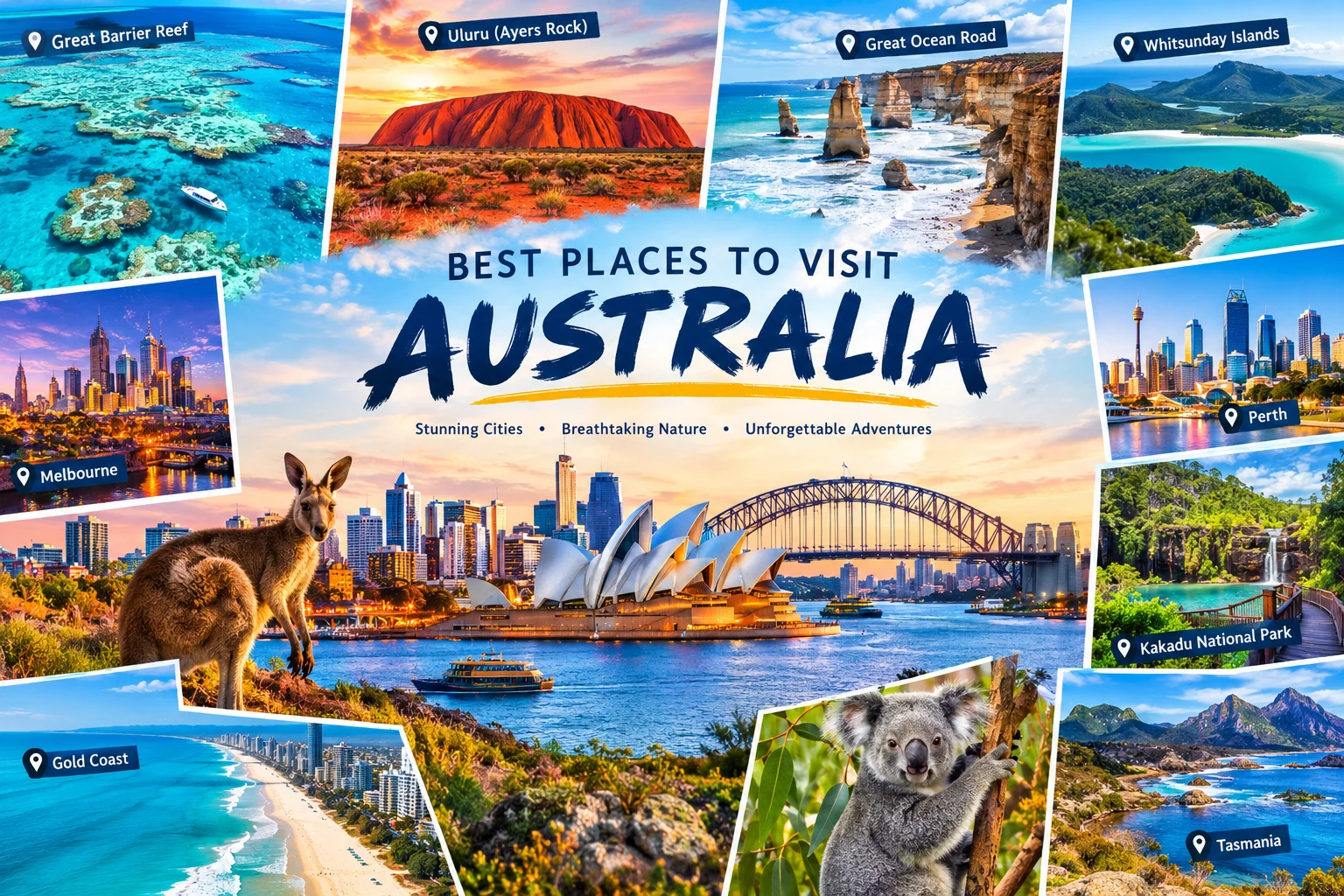
Best Places to Visit Australia: An Insider’s Guide to the Land Down Under
Introduction
Planning a trip to Australia feels like trying to drink from a fire hose. The country is roughly the size of the United States, yet most visitors try to cram it into two weeks. I’ve watched countless travelers make that mistake—exhausted, broke, and staring at a rental car they barely used.
Here’s the truth: you can’t see it all. You shouldn’t even try. Australia’s best places deliver experiences you cannot replicate anywhere else on Earth. Ancient rainforests. Reefs teeming with life. Cities where coffee is treated like religion.
This guide cuts through the noise. I’ll show you exactly where to go, when to visit, and why each destination earns its spot on your itinerary. No fluff. No filler. Just battle-tested recommendations from someone who’s made the mistakes so you don’t have to.
Quick Answer: The best places to visit in Australia include Sydney for iconic landmarks, Cairns for the Great Barrier Reef, Melbourne for culture and food, Uluru for outback spirituality, and the Gold Coast for family fun. Visit during spring or autumn for ideal weather.
What Are the Absolute Best Places to Visit in Australia for First-Timers?
Direct Answer: For first-time visitors, Sydney, Cairns, Melbourne, and Uluru offer the most iconic Australian experiences in one trip.
Look, I get it. You’ve saved for years. You’ve got two, maybe three weeks. And you want to see everything.
Stop. Breathe. Prioritize.
Sydney should be your starting point. Not because it’s the “best” city—locals will argue about that forever—but because it delivers that jaw-dropping moment. The Opera House. The Harbour Bridge. Bondi Beach. You’ve seen these images your whole life. Seeing them in person hits different.
Cairns gives you access to two World Heritage sites: the Great Barrier Reef and the Daintree Rainforest. Nowhere else on Earth offers this combo. Snorkel with clownfish in the morning, wander through a rainforest older than the Amazon in the afternoon.
Melbourne is Sydney’s cooler, more complicated sibling. Street art. Rooftop bars. Coffee that ruins you for everywhere else. The best cities to visit in Australia for food and culture, hands down.
Uluru sits at the continent’s spiritual heart. This isn’t just a big rock. It’s a living cultural landscape for the Anangu people. The sunrise and sunset colors will silence even the most cynical traveler.
Key Takeaway:
- Sydney, Cairns, Melbourne, and Uluru cover the essential Australian experiences
- Two to three weeks lets you see these without losing your mind
- Accept you’ll miss things. That’s your excuse to return.
Which Australian Destinations Deliver the Best Beaches?
Direct Answer: Australia’s best beaches include Whitehaven Beach (Whitsundays), Bondi Beach (Sydney), Lucky Bay (Esperance), and Wineglass Bay (Tasmania).
Australia has over 10,000 beaches. You will not visit them all. Here are the ones that matter.
Whitehaven Beach in the Whitsundays isn’t just white—it’s blindingly, almost unnaturally white. The sand is 98% pure silica. It squeaks when you walk on it. The swirling turquoise and white patterns where sand meets water create natural art that changes every hour.
Bondi Beach is Sydney’s beach culture distilled. Yes, it’s crowded. Yes, it’s touristy. But watching the sunrise over the Pacific while surfers paddle out at first light? That’s a core memory. The coastal walk from Bondi to Coogee ranks among the most beautiful places in Australia.
Lucky Bay near Esperance in Western Australia offers something no other beach can: kangaroos lounging on the sand. Actual kangaroos. Sunbathing. Next to your towel. The water here is that impossible shade of blue you thought only existed in filters.
Wineglass Bay in Tasmania’s Freycinet National Park requires a hike to reach. That’s the point. The payoff—a perfect curve of white sand framed by pink granite peaks—feels earned. The lookout above the bay ranks among the best tourist attractions in Australia for sheer natural drama.
Key Takeaway:
- Whitehaven Beach offers the most stunning sand and water combination
- Lucky Bay gives you kangaroos on the beach—a uniquely Australian experience
- Wineglass Bay rewards those willing to hike for their views
What Are the Best Australian Destinations for Families?
Direct Answer: The Gold Coast, Sydney, Cairns, and Kangaroo Island rank as the best Australian destinations for families.
Traveling with kids changes everything. You need destinations that balance “wow” moments with practical logistics. Meltdowns happen. Nap schedules matter.
Gold Coast exists for family fun. Theme parks like Dreamworld and Sea World. Patrolled beaches perfect for little swimmers. Wildlife sanctuaries where kids can hand-feed kangaroos. The best places to visit in Australia for families often sacrifice authenticity for convenience—the Gold Coast doesn’t pretend otherwise.
Sydney works surprisingly well for families. The ferry network turns transportation into sightseeing. Darling Harbour packs SEA LIFE Aquarium, the Maritime Museum, and playgrounds into one walkable zone. Bondi’s ocean pool at Icebergs gives kids a safe swim with a legendary view.
Cairns delivers the reef experience without overwhelming kids. The Cairns Lagoon offers a free, patrolled swimming spot in the city center. Day trips to the reef, the Daintree, and Kuranda give you a full nature curriculum without the military-style itinerary.
Kangaroo Island off South Australia’s coast might be the dark horse here. Sea lions napping on beaches. Sand dunes begging to be sledded. Wildlife everywhere. Kids see more animals than people. That’s magic.
Key Takeaway:
- Gold Coast offers the most theme parks and kid-focused activities
- Sydney combines education and fun with easy logistics
- Kangaroo Island delivers wildlife encounters kids will remember forever
When Should You Visit Australia’s Top Destinations?
Direct Answer: Visit southern Australia (Sydney, Melbourne, Tasmania) from October to April and northern Australia (Cairns, Darwin, Broome) from May to October.
Australia’s seasons run opposite to the Northern Hemisphere. December is summer. July is winter. This trips up more travelers than any other detail.
Summer (December-February) brings heat and crowds to the southern cities. Sydney and Melbourne hum with outdoor festivals, beach days, and long twilight evenings. But prices spike. Book accommodation months ahead.
The northern tropics enter their wet season—hot, humid, and drenched. Avoid Cairns and Darwin unless you enjoy sweating through your clothes.
Autumn (March-May) and spring (September-November) are Australia’s golden windows. Mild temperatures. Fewer crowds. Lower prices.
This is when the best places to visit in Australia become genuinely enjoyable rather than a battle with heat and tourists. The reef offers clear water and sunny days. Uluru delivers comfortable desert temperatures.
Winter (June-August) flips the script. The southern cities cool down. Melbourne gets moody and atmospheric. But the north? Perfect. Dry season in Cairns means endless sunshine and ideal reef conditions. Uluru’s desert nights get cold, but the days are glorious.
Key Takeaway:
- Spring and autumn offer the best overall conditions nationwide
- Visit the reef and outback in winter (June-August)
- Summer means crowds, heat, and higher prices—but also festival energy
Which Unique Australian Destinations Deserve Your Time?
Direct Answer: K’gari (Fraser Island), Kakadu National Park, and the Flinders Ranges offer unique Australian experiences beyond the typical tourist trail.
Beyond the postcard destinations, Australia hides places that feel like another planet.
K’gari (formerly Fraser Island) is the world’s largest sand island. You drive on the beach. Literally—75 Mile Beach serves as the highway. Ancient rainforest grows from pure sand. Lake McKenzie’s water is so pure it won’t support fish. Dingoes roam wild. This place defies logic.
Kakadu National Park in the Northern Territory holds Aboriginal rock art dating back 25,000 years. That’s older than the pyramids. The landscapes shift from wetlands teeming with crocodiles to rugged escarpments hiding waterfalls. The Bininj/Mungguy people still call this home and share their culture directly with visitors.
Flinders Ranges in South Australia contain Wilpena Pound—a natural amphitheater eight times the size of Uluru. The landscape dates back 600 million years. Hiking here feels like walking through geological time. Most international visitors skip it entirely. That’s their loss.
Key Takeaway:
- K’gari offers 4WD adventures on the world’s largest sand island
- Kakadu provides access to the world’s oldest living culture
- Flinders Ranges delivers outback drama without the crowds
FAQs
Question: What is the best place to visit in Australia for first-timers?
Answer: Sydney tops the list for first-timers. It delivers iconic landmarks (Opera House, Harbour Bridge), world-class beaches (Bondi), and easy access to the Blue Mountains. From Sydney, add Cairns for the reef and Uluru for the outback. These three cover Australia’s greatest hits.
Question: How many days do you need to see Australia’s best places?
Answer: Three weeks minimum. Australia is massive. A week covers one city and its surrounds. Two weeks lets you combine Sydney and Cairns. Three weeks opens up Melbourne, Uluru, and a coastal drive. Anything less means you’re spending more time in airports than experiencing the country.
Question: What is the cheapest time to visit Australia?
Answer: The shoulder seasons—March to May and September to November—offer the best value. Flights cost less than during the summer peak. Accommodation prices drop. Weather remains pleasant across most regions. Avoid December-January school holidays and Easter when domestic tourism spikes.
Question: Is Australia expensive for tourists?
Answer: Yes, Australia ranks among the pricier destinations. Meals average $20-30 AUD. Accommodation in major cities starts around $150 AUD per night. But the favorable exchange rate for many currencies helps. Budget travelers can use hostels, cook their own meals, and focus on free attractions like beaches and coastal walks.
Question: What should I not miss in Australia?
Answer: Don’t miss the Great Barrier Reef from Cairns, sunrise at Uluru, the coastal walk from Bondi to Coogee, and a meal in Melbourne’s laneways.
Conclusion
Choosing the best places to visit in Australia comes down to one question: what do you actually want to feel?
If you want awe, stand before Uluru at sunset. If you want wonder, float above the Great Barrier Reef. If you want to understand Australian culture, drink coffee in Melbourne and watch the surfers at Bondi. If you want to disconnect, drive through K’gari’s sand highways or hike Tasmania’s wilderness.
I’ve made the mistake of over-scheduling. I’ve also learned the magic of lingering longer in one place. The travelers who love Australia most aren’t the ones who checked off the most destinations. They’re the ones who sat still long enough to let the country sink in.
The Bottom Line: Australia rewards those who respect its scale. Pick three or four destinations. Give each proper time. Visit in spring or autumn for ideal conditions. Book ahead during peak periods. And accept that you’ll leave with a longer list than you arrived with—that’s not failure, it’s Australia.
Ready to plan your Australian adventure? Drop a comment with your dream destination. Share this guide with your travel crew. And start booking—the Land Down Under won’t wait.
References
- Tourism Australia. “Australia’s Top 10 Destinations.” australia.com, 2025.
- Lonely Planet. “Best Beach Towns in Australia.” lonelyplanet.com, 2025.
Read More: Best Places to Visit Singapore
Top 5 Travel Packages for Australia: September – December 2026
Curated guided tours and self-drive itineraries featuring Australia’s most iconic destinations.
| Package & Operator | Route & Duration | Highlights | Indicative Price (AUD) | Travel Window |
|---|---|---|---|---|
| Contrasts of Australia Trafalgar Tours |
9 Days / 8 Nights
Melbourne → Cairns → Sydney
|
|
$8,061 – $8,760 per person twin share | Sep 24 – Dec 11, 2026 |
| Tasmania Adventure Intrepid Travel |
6 Days / 5 Nights
Hobart → East Coast → Cradle Mountain → Hobart
|
|
$2,800 – $3,500 per person twin share (est.) | Sep – Dec 2026 |
| 5-Day Uluru & Kings Canyon Uncovered ANZCRO / Emu Run |
5 Days / 4 Nights
Ayers Rock → Kings Canyon → Alice Springs
|
|
$3,078 – $3,246 per person twin share | Sep – Dec 19, 2026 |
| Tasmanian Wonders AAT Kings |
10 Days / 9 Nights
Hobart → Strahan → Cradle Mountain → Launceston
|
|
$5,166 – $5,615 per person twin share (last-minute deal) | Oct 2026 departures |
| Australia: Beaches & Reefs Contiki |
16 Days / 15 Nights
Sydney → Byron Bay → Whitsundays → Cairns
|
|
$4,223 per person (Dec 15, 2026 departure) | Dec 15 – 30, 2026 |
- Rates may vary by departure date within the stated travel windows.
- Single supplements, domestic flights (unless specified as included), travel insurance, personal expenses, and optional activities are generally not included unless explicitly stated.
- Blackout dates and holiday surcharges may apply.
- Package inclusions and itineraries are subject to change by the tour operator.
- Always confirm the final price and full inclusions directly with the tour operator or your travel agent before booking.